Dry Eye
Dry Eye Care: Comprehensive & Solution‑Oriented
Relief starts with understanding the condition—not just the symptoms.
A Disease‑First Approach to Dry Eye Care
Dry Eye is not just occasional irritation--it is a multifactorial, chronic disease of the ocular surface that affects the quality and/or quantity of tears. Because of its complexity and individualization, we take a comprehensive, stepwise approach to diagnosing and managing it.
At BayCare Clinic Eye Specialists, Dr. Kimberly Schauland and Dr. Noa Robson work with you to identify the root causes and build a care plan that improves comfort and stabilizes vision over time.
- Best outcomes come from a structured plan requiring evaluation, targeted therapies, and ongoing treatment/follow-ups.
- Your plan adapts as your eyes change. We manage the disease, not just the symptoms.
What Causes Dry Eye?
Dry Eye typically arises from multiple factors. We group common (but not all inclusive) causes into three main categories:
Age & Environment
- Age
- Dry/air-conditioned environments
- Tobacco exposure
- Screen time (reduced blink rate)
Eye Related Causes
- All eye surgeries (including cataract and LASIK/PRK)
- Glaucoma therapy (drops and/or surgery)
- Retinal injections
- Contact lens wear
Systemic Diseases & Medications
- Diabetes
- Autoimmune disease (Sjogrens, Rheumatoid arthritis, Sarcoidosis, etc.)
- Sleep apnea/CPAP use
- MS - Multiple Sclerosis
- History of cancer (with/without chemotherapy)
- Hormonal changes
- Prior shingles/herpes
- Current or past oral/topical medications
The Ocular Surface: Lids • Tears • Cornea
The Lids
Blinking spreads and secretes components of the tear film, protects the surface, removes debris, and replenishes tears.
The Tears (3 layers)
Each layer is produced by separate glands; both quantity and quality must be adequate to maintain a healthy ocular surface.
The Cornea
A smooth, healthy corneal surface and a stable tear film are essential for clear, stable vision. Corneal epithelium and corneal nerves are directly linked to ocular surface health.
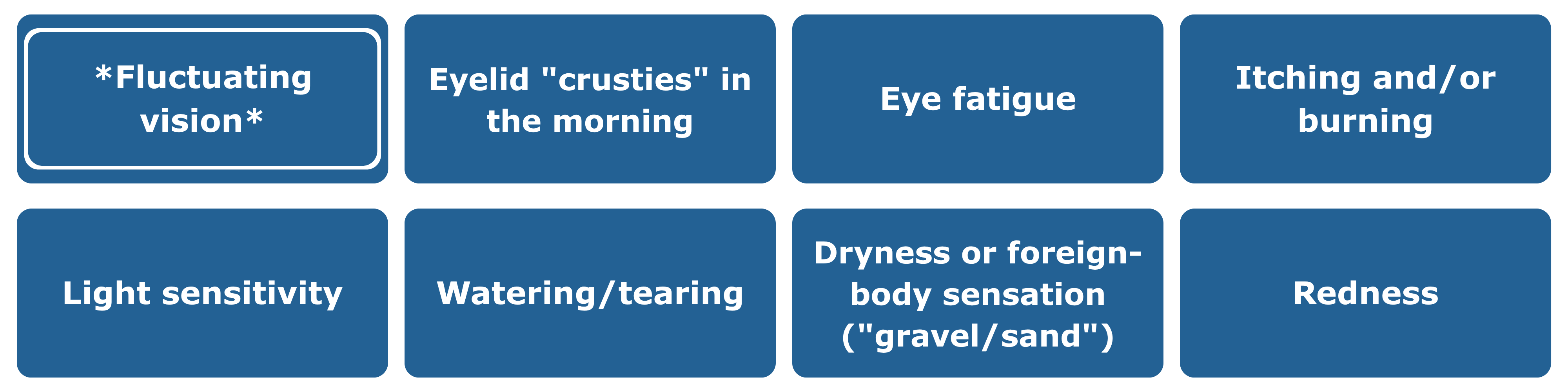
Symptoms can vary- minute to minute, daily, or even weekly.
How We Diagnose Dry Eye
We perform a structured evaluation to identify root causes and create an individualized management/treatment plan.
- Detailed history (environment, surgery, systemic conditions, medications)
- Slit-lamp examination of lids, lashes, meibomian glands, conjunctiva, and cornea
- Tear film quality and quantity assessment
- Additional testing as indicated
- Outcome: A clear, personalized plan with measurable goals and a follow-up schedule.
Treatment Options for Dry Eye
Treatment for dry eye is ongoing; the condition is a chronic, incurable disease. Our care model is solution oriented. We address the underlying causes and tailor the plan to your eyes.
Lifestyle & Home Care
- Optimize control of systemic conditions
- Avoid car vents directed at your face
- Use a small bedside humidifier while sleeping
- Increase water intake
- Wear protective eyewear outdoors
- Take regular breaks from screens (e.g. 20-20-20 rule)
- Avoid fans while sleeping
In-Office & Prescription Therapies
- Over the counter drops/ointments/lid scrubs
- Prescription drops and ointments
- Irrigation - flushing debris/inflammation from the ocular surface and drainage system
- BioTissue amniotic membranes - a biological medical contact lens temporarily placed on the eye to aid in healing
- NuLids - an in-office procedure to deeply clean the eyelashes and lids, aiming to improve symptoms from dry eye, blepharitis, meibomian gland dysfunction, and/or demodex
- ZEST - an in-office, okra-based procedure to deeply clean the eyelashes and lids improving symptoms from dry eye, blepharitis, meibomian gland dysfunction, and/or demodex
- MGRx Meibomian gland expression- an in-office treatment combining heat debridement, and meibomian gland expression into a single, efficient procedure
- Lacrifill punctal plugs - Hyaluronic acid inserted into the punctum to help to retain your natural tear volume
- Blood serum tears - custom eye drops made from a patient's blood serum, processed into a nutrient-rich solution that resembles natural tears
- Rinsada - flushing debris/inflammation from the ocular surface and drainage system
Follow-Up & Progress Tracking
- We adjust your plan as your eyes respond
- The focus is comfort and visual stability
- Book an appointment: Request an Appointment | BayCare Clinic
- Call: 920-327-7000
FAQs About Dry Eye
Q: How long does it take to see improvement with treatment?
A: Some patients notice changes within 4-6 weeks, especially with consistent home care and targeted therapies. Chronic cases may require 3-6 months (or longer) for measurable, sustained improvement. We'll set expectations and checkpoints together.
Q: Is dry eye disease permanent?
A: Dry eye is chronic, but many people achieve excellent symptom control with a structured plan and periodic adjustments.
Q: Is dry eye curable?
A: There is no "cure", but the disease is highly manageable. Our goal is long-term stability and comfort.
Q: Will insurance cover my treatment?
A: Coverage varies by plan and service. Diagnostic visits are often covered; some treatments may be self-pay. Our team will review your benefits and provide cost clarity before starting.
Meet Your Care Team
Expert Care, Collaborative Support
Dr. Noa Robson and Dr. Kimberly Schauland are committed to comprehensive dry eye management--pairing clinical expertise with patient education; transparent expectations, and stepwise care.
Ready for relief?
Accepting patients in Green Bay and Manitowoc.
Book your visit today: Request an Appointment | BayCare Clinic
Call to schedule: 920-327-7000
Providers


Our locations

Aurora BayCare Health Center in Green Bay - BayCare Clinic Eye Specialists
Green Bay
Location Details read_more